Why Your Child’s Posture Could Be Shaping Their Sport, School and Stress Levels
Watch a group of Chatswood kids waiting for the school bus and you’ll notice something their parents’ generation never did — a row of bowed heads, curved spines and shoulders rolled forward over glowing screens. At Family Chiropractic Chatswood, we believe posture is one of the most overlooked factors in a child’s health, learning and athletic development. And in a screen-saturated world, it deserves far more attention than it gets.
As Chatswood’s longest-serving chiropractor with over 30 years caring for local families, here’s what I want every parent on the North Shore to understand.
Australian Kids Are Sitting More Than Ever
The numbers are sobering:
- Only 1 in 4 (27%) Australian children aged 13–17 stay within the recommended 2-hour daily limit for recreational screen time
- Just 7.9% of 13–17 year-olds meet the national physical activity guidelines — meaning more than 9 in 10 aren’t moving enough
- Around 90% of Australian children now use mobile devices for more than 20 hours per week — roughly double 2019 levels
- Physical activity drops steadily with age, falling from 61% of 2–5 year-olds meeting guidelines to under 8% by the teenage years
More screens, less movement, and a growing spine caught in the middle.
What Screen Time Does to a Growing Spine
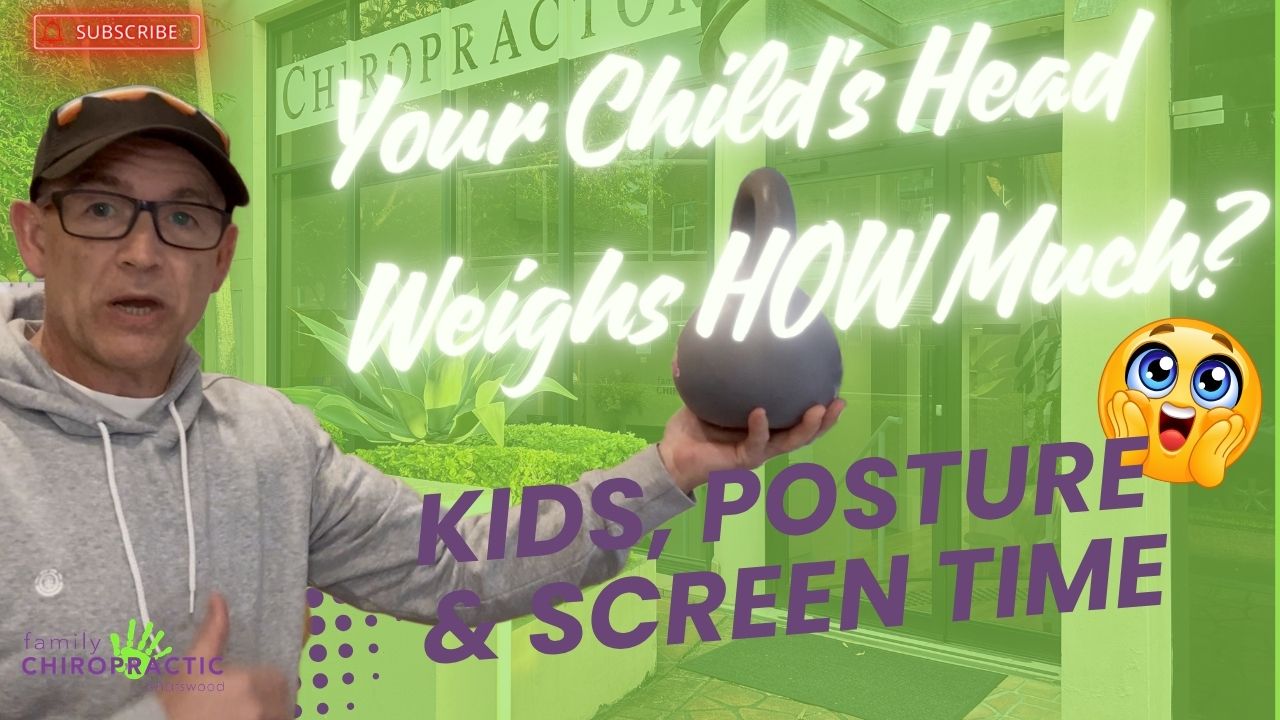
When a child looks down at a device, the head — which weighs around 5kg upright — tilts forward and the load on the neck multiplies. At a 60-degree “phone angle,” that load can reach the equivalent of 27kg. For a still-developing spine, hours of this every day encourages forward head posture: the head drifts ahead of the shoulders, the upper back rounds, and the deep postural muscles that should hold the head upright weaken.
The concern isn’t a single bad moment — it’s repetition during the growth years. Habits and structures forming at age 10 can echo for a lifetime.
Posture and Sport: The Performance Connection
Good posture isn’t just about looking upright — it’s the foundation of how a child moves. Forward head posture and rounded shoulders can:
- Reduce shoulder mobility — affecting swimming, throwing, racquet sports and overhead movements
- Alter balance and gait — research shows forward head posture changes walking biomechanics and how the body distributes load
- Restrict breathing — a slumped chest reduces lung capacity, and less oxygen means less endurance on the field or in the pool
- Increase injury risk — a body that’s out of alignment doesn’t absorb and transfer force efficiently
For young athletes, posture is quite literally the platform their performance is built on. (As a swimmer of over 50 years myself, I see this in the water constantly — technique breaks down when posture does.)
Posture, the Classroom and the Stress Response
Here’s the connection most parents have never heard — and it’s the one that matters most for school.
Slumped, forward-head posture doesn’t just strain muscles. It can actually tip the nervous system toward a stress response. When the chest is compressed and breathing becomes shallow, the body shifts away from the calm “rest and digest” (parasympathetic) state and toward “fight or flight” (sympathetic) dominance. This subtle, sustained stress response is associated with higher levels of stress hormones like cortisol.
Why does that matter for a student sitting at a desk?
- Concentration & attention: A brain in low-grade stress mode struggles to focus and filter distractions
- Memory: Elevated cortisol is linked with poorer working memory and recall — the very tools a child needs for learning
- Learning & mood: Forward head posture is associated with reduced brain blood flow and lower mood, while an upright posture is linked with improved attention, confidence and even memory recall
- Inflammation: Chronic activation of the stress response is associated with higher systemic inflammation, which affects overall health, recovery and wellbeing
In other words, the way your child sits may be quietly influencing how well they think, feel and learn. Posture and the nervous system are deeply connected — which is exactly why we take a wholistic view.
The Chiropractic, Wholistic Perspective
At Family Chiropractic Chatswood, we don’t see posture as a cosmetic issue. Your child’s spine houses and protects their nervous system — the master control system coordinating everything from movement and breathing to focus and mood. Our approach rests on three simple pillars — Alignment, Activation and Awareness:
- Alignment — assessing spinal alignment and posture
- Activation — supporting healthy nervous system function with gentle, drug-free care
- Awareness — helping families build lasting habits at home, at school and on the sports field
Every child is different, so care is always based on individual assessment findings.
6 Things Parents Can Do This Week
- Raise screens to eye level — bring the device up, not the head down
- Set the 2-hour recreational limit — and protect the hour before bed
- Encourage daily movement — swimming, ball sports, climbing, walking to school
- Create a “posture-friendly” study space — feet flat, screen at eye level, back supported
- Model it yourself — kids mirror their parents’ posture and screen habits
- Get their posture assessed — early is easier than late
Give Your Child a Strong Foundation
Your child’s posture today is helping shape their health, confidence and performance for years to come. A quick, gentle assessment can reveal a lot — and it’s one of the simplest investments you can make in their wellbeing.
Book your child’s complimentary initial consultation — call (02) 9415 4606 or visit Family Chiropractic Chatswood, 7/7 Kirk St, Chatswood NSW 2067. Gentle, drug-free, family-focused care from Chatswood’s longest-serving chiropractor.
FREQUENTLY ASKED QUESTIONS
Is chiropractic safe for children?
Chiropractic care for children uses very gentle, low-force techniques adapted to a child’s size and stage of development. At Family Chiropractic Chatswood, Dr. Brett Grant is a national Activator Technique instructor with over 30 years of experience, and every child receives an individual assessment before any care. Always discuss your child’s specific health needs during their consultation.
How does screen time affect my child’s posture?
Looking down at phones and tablets encourages forward head posture, where the head drifts ahead of the shoulders and the upper back rounds. Because a child’s spine is still developing, repeated hours in this position each day can reinforce poor postural patterns and weaken the muscles that hold the head upright.
Can poor posture affect my child’s concentration and learning?
Emerging research suggests it can. Slumped, forward-head posture promotes shallow breathing and can shift the nervous system toward a stress response, associated with higher cortisol. Elevated stress hormones are linked with poorer concentration and working memory, while upright posture is associated with improved attention, mood and recall.
Can posture affect my child’s sport performance?
Yes. Forward head posture and rounded shoulders can reduce shoulder mobility, alter balance and gait, and restrict breathing and lung capacity — all of which affect endurance, coordination and technique. Good posture provides the stable platform that efficient, powerful movement is built on.
How much screen time is recommended for children in Australia?
Australian guidelines recommend no more than 2 hours per day of recreational (non-homework) screen time for children and teenagers aged 5–17. However, only around 1 in 5 Australian teens actually stays within this limit.
At what age can a child see a chiropractor for posture?
Children of many ages can be assessed for posture and spinal health, as care is always tailored and gentle. Because postural habits form during the growth years, early assessment can be valuable. Book a consultation to discuss what’s appropriate for your child.
What are the signs of poor posture in kids?
Common signs include a head that sits forward of the shoulders, rounded shoulders, slouching when sitting, uneven shoulders, frequent neck or back complaints, headaches, fatigue and a tendency to slump over screens. If you notice these, a professional posture assessment can help.
How can I improve my child’s posture at home?
Raise screens to eye level, limit recreational screen time to around 2 hours a day, set up a supportive study space, encourage daily physical activity and sport, take regular movement breaks, and model good posture yourself. A professional assessment can identify specific areas to address.
Who is the best chiropractor for kids near me in Chatswood?
Family Chiropractic Chatswood, led by Dr. Brett Grant, is Chatswood’s longest-serving chiropractic practice with over 30 years of family care. Dr. Brett is a multi-award-winning chiropractor and national Activator Technique instructor, offering gentle, drug-free care for children and adults. Located at 7/7 Kirk St, Chatswood, with a complimentary initial consultation. Call (02) 9415 4606.
Does chiropractic care for kids cost anything to start?
Family Chiropractic Chatswood offers a complimentary initial consultation, which includes discussing your child’s health and assessing their posture and spinal function. Call (02) 9415 4606 to book.