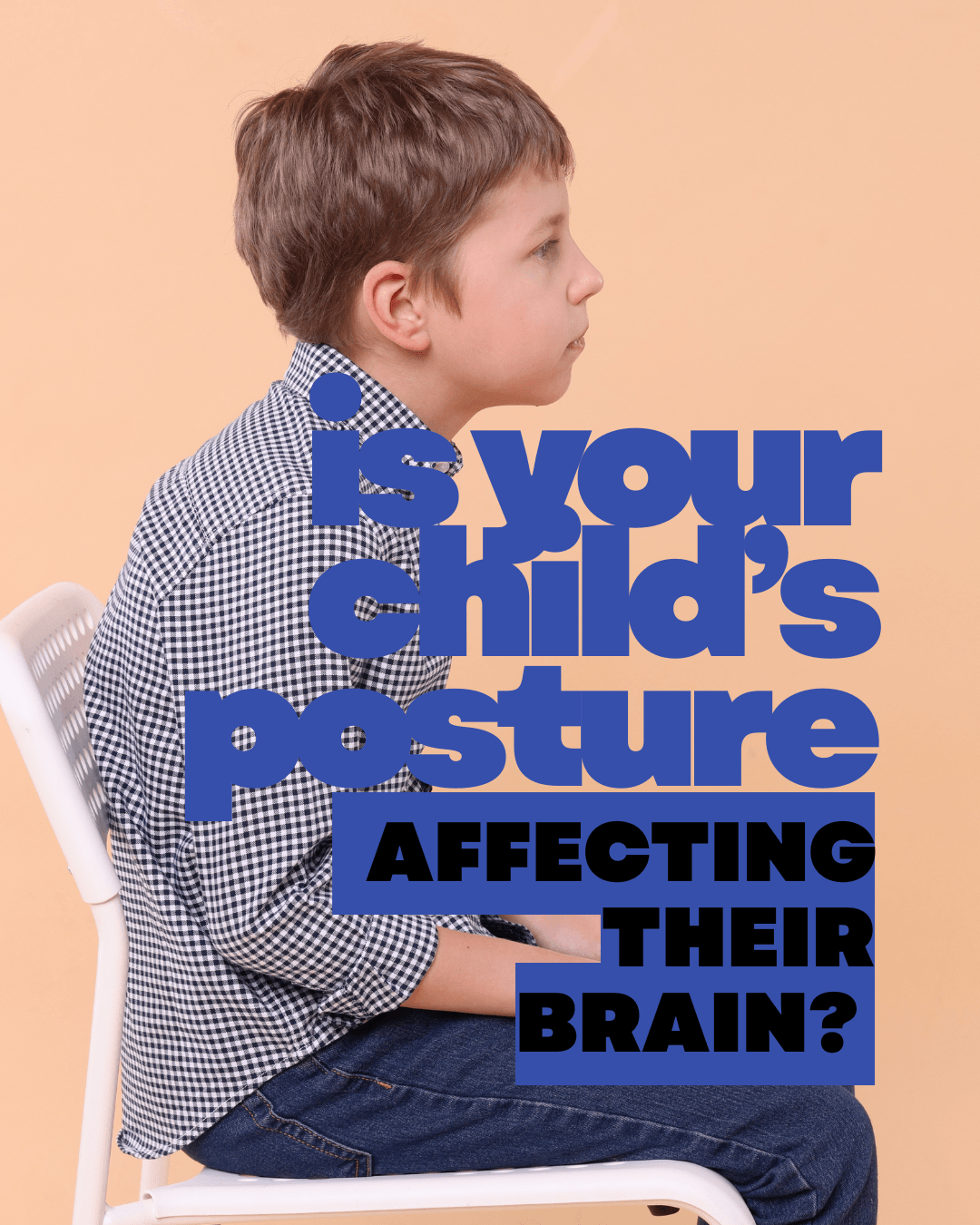
Quick summary: Over the years, one of the biggest issues parents get is that of their child’s posture. Most parents worry about how much screen time their child gets. But fewer realise that how their child sits during that screen time may be just as important — and the impact goes far beyond a sore neck.The Concern Most Parents Miss
You’ve probably set screen time limits. You’ve heard the debates about social media, blue light, and sleep. But here’s a question most parents haven’t considered:
What is your child’s posture doing to their brain while they scroll?
Poor posture during device use isn’t just a cosmetic issue. Emerging research and clinical understanding suggest that the position of the head and spine during prolonged screen use may influence how the nervous system functions — and by extension, how children think, focus, and sleep.
The Posture–Brain Connection: More Than Just Structure
Most people think of posture as a structural concern — something that affects the back and neck. But posture is also neurological.
The spine houses and protects the spinal cord, which acts as the main communication highway between the brain and the body. Every message the brain sends — and every signal the body sends back — travels through this pathway.
When spinal alignment is compromised, that communication can be affected. This is why chiropractors and neuroscientists alike are paying closer attention to posture not just as a musculoskeletal issue, but as a brain health issue.
What Happens to the Spine During Screen Time?
Children today spend hours each day looking down at phones, tablets, and laptops. Over time, this creates a pattern called forward head posture — where the head drifts in front of the shoulders rather than sitting balanced over the spine.
Here’s why that matters:
Increased Spinal Load
The average adult head weighs around 4–5 kg when held in a neutral position. But for every 2.5 cm the head moves forward, the effective load on the cervical spine roughly doubles. For a child in extended forward head posture, the spine may be bearing the equivalent of two to three times the normal load — for hours at a time.
Muscle Fatigue and Tension
Holding the head in a forward position requires the muscles of the neck and upper back to work continuously. Over time, this leads to chronic muscle fatigue and tension — something many children are increasingly experiencing, even at primary school age.
Nervous System Efficiency
The nervous system operates best when the spine is in healthy alignment. When postural stress is sustained — particularly at the upper cervical spine — it may affect how efficiently nerve signals are transmitted and processed.
How This May Affect Your Child Day to Day
This isn’t just about headaches or a stiff neck. The downstream effects of poor posture and nervous system stress may include:
- Difficulty concentrating — Children with chronic postural strain often report brain fog or an inability to focus, even after adequate sleep.
- Low energy — When the body is working harder just to hold the head up, overall energy reserves can drop.
- Disrupted sleep — Nervous system dysregulation and physical discomfort can interfere with sleep quality, which in turn affects mood, learning, and immune function.
- Increased irritability — Physical tension and poor sleep are a difficult combination for growing children.
These are subtle effects that can be easy to attribute to other causes — diet, personality, screen content — when posture may be a significant contributing factor.
What the Research Suggests
Studies examining the relationship between spinal health, posture, and neurological function are still developing, but the direction is clear. Research has shown that:
- Forward head posture is associated with reduced respiratory function, which affects oxygen delivery to the brain.
- Chronic mechanical stress on the upper cervical spine may affect brainstem function and autonomic nervous system regulation.
- Children’s spines are more adaptable than adults’ — meaning both more susceptible to postural changes and more responsive to correction.
How Chiropractic Care May Help
Chiropractic care focuses on assessing and improving spinal function — and by extension, supporting the nervous system.
For children who spend significant time on devices, a chiropractic assessment can:
- Identify postural changes that may not yet be causing obvious symptoms
- Assess spinal function to see whether nerve communication pathways are being affected
- Provide gentle, appropriate adjustments to help restore alignment and reduce mechanical stress
- Recommend postural strategies for device use at home and at school
Chiropractic care for children is gentle and adapted to the needs of growing bodies. Many parents are surprised to learn how straightforward a paediatric assessment can be.
Practical Tips for Parents: What You Can Do Now
While professional assessment is worthwhile, there are also simple things you can start doing at home:
- Raise the screen. Position tablets and screens at eye level wherever possible to reduce forward head positioning.
- Take regular breaks. Encourage your child to take a 5-minute break for every 30–45 minutes of screen use.
- Encourage movement. Physical activity helps reset postural muscles and supports nervous system balance.
- Check in on posture. Gently remind children to sit upright — but also address the ergonomics, not just the behaviour.
- Watch for signs. Frequent headaches, complaints of neck or shoulder pain, poor sleep, or difficulty concentrating are all worth investigating further.
Is It Worth Getting Your Child Assessed?
If your child is spending several hours a day on devices — and most school-age children are — then yes, a posture and spinal function assessment is worth considering.
The question isn’t whether screen time is happening. It’s whether you’re taking a proactive approach to managing its physical and neurological effects.
A chiropractor experienced in paediatric care can give you a clear picture of where your child’s posture is now, and what (if anything) needs attention.
Final Thought
We invest a great deal of energy thinking about what our children consume on screens. It’s time we also paid attention to what those screens are doing to their spines — and what their spines may be doing to their brains.
If you have questions about your child’s posture or would like to book an assessment, contact our practice today.