Chiropractic and the Vagus Nerve: What the Science Actually Says
The vagus nerve has really made its way for the forefront of wellness conversations lately — and honestly, for good reason. It’s one of the most influential nerves in your entire body, quietly running the systems that help you rest, digest, repair, recover and feel calm.
In more than 30 years caring for families here in Chatswood, one of the questions I’m asked most often is: “Can chiropractic stimulate my vagus nerve?”
Let me give you an honest, clinically grounded answer — because this is exactly the kind of nuance that gets lost in the noise online.
The short answer: It’s complex! Chiropractic does not directly treat or “switch on” the vagus nerve. What chiropractic care does is enhances the overall function of your nervous system — including the parasympathetic (“rest and digest”) system that the vagus nerve is a major part of. This is done by improving spinal movement and reducing stress on the body.
That’s a meaningful distinction, and it’s the reason I wanted to write this. Let’s unpack it properly.
What Is the Vagus Nerve?
The vagus nerve is the longest cranial nerve in your body. It begins in your brainstem, travels down through your neck, and branches out into your chest and abdomen — connecting to many of your major organs, including your:
- Heart
- Lungs
- Stomach
- Liver
- Pancreas
- Small and large intestine
Think of it as a two-way communication highway between your brain and your body. Fascinatingly, around 80% of its fibres carry information upward — from your organs back to your brain — constantly reporting on what’s happening inside you.
Why the Vagus Nerve Matters So Much
The vagus nerve helps regulate the automatic functions you rarely stop to think about. Here are the big ones.
Heart rate
A healthy vagal response helps slow your heart when appropriate and supports healthy heart rate variability (HRV) — a well-recognised marker of how adaptable your nervous system is.
Digestion
It helps stimulate stomach acid, coordinate digestive enzymes, move food through the intestines, and regulate bowel movements. Poor vagal function has been linked with digestive discomfort in some people.
Breathing
It coordinates your breathing patterns and the communication between your lungs and brain.
Your stress response
This is the big one. The vagus nerve is central to switching your body out of fight or flight (the sympathetic nervous system) and into rest, digest and recover (the parasympathetic nervous system). When it’s working well, you generally bounce back from stress more efficiently.
Think of your parasympathetic nervous system much like the brake pedal of your car, and the sympathetic nervous system much like the accelerator. They both can not work at the same time. It is an either/ or response. In today’s day and age with continual physical, chemical and emotional stressors, tech neck and poor posture, a lack of movement, and a diet that is incongruent to our genetic makeup, the vagus nerve really never gets the opportunity to turn on.
Modern Life Is Waging War on Your Vagus Nerve
Here’s what I see every single day in the clinic. Modern life keeps us stuck in “fight or flight.” The usual suspects:
- Poor posture and “tech neck“
- Excessive sitting
- Constant screen time
- Poor sleep
- Chronic stress
- Processed foods
- Lack of movement
- Emotional overload
When that stress becomes constant, people describe feeling “stuck in overdrive.” They come in with a familiar cluster of complaints: poor sleep, digestive discomfort, muscle tension, headaches, low energy, and an inability to switch off and relax.
Sound familiar? You’re not imagining it — and you’re certainly not alone.
So Where Does Chiropractic Fit In?
Chiropractic is all about the relationship between your nervous system and how well your body functions as a whole.
Your spine protects your spinal cord, and your brain communicates with the rest of your body through the nervous system. When spinal joints become restricted or aren’t moving well, they may alter the sensory information travelling between your body and your brain.
Chiropractic adjustments are designed to restore joint movement and improve spinal function, which in turn influences how your nervous system processes information. Research suggests spinal adjustments can influence activity within the central and autonomic nervous system.
Precision in the spinal adjustments matters enormously to me here. Gentle, specific, individually assessed adjustments are about supporting your nervous system — not applying a one-size-fits-all fix.
Chiropractic and the Parasympathetic Nervous System
Several studies have looked at how chiropractic adjustments affect autonomic nervous system activity. Researchers have observed changes in HRV, blood pressure, muscle activity, brain function and stress responses.
HRV is especially interesting because it reflects the balance between your sympathetic and parasympathetic systems. Higher HRV is generally associated with greater adaptability and resilience.
Studies have found improvements in HRV following spinal adjustments which suggests chiropractic care support sparasympathetic activity in some individuals.
The Upper Neck Connection
Here’s the part that fascinates me most after three decades in practice.
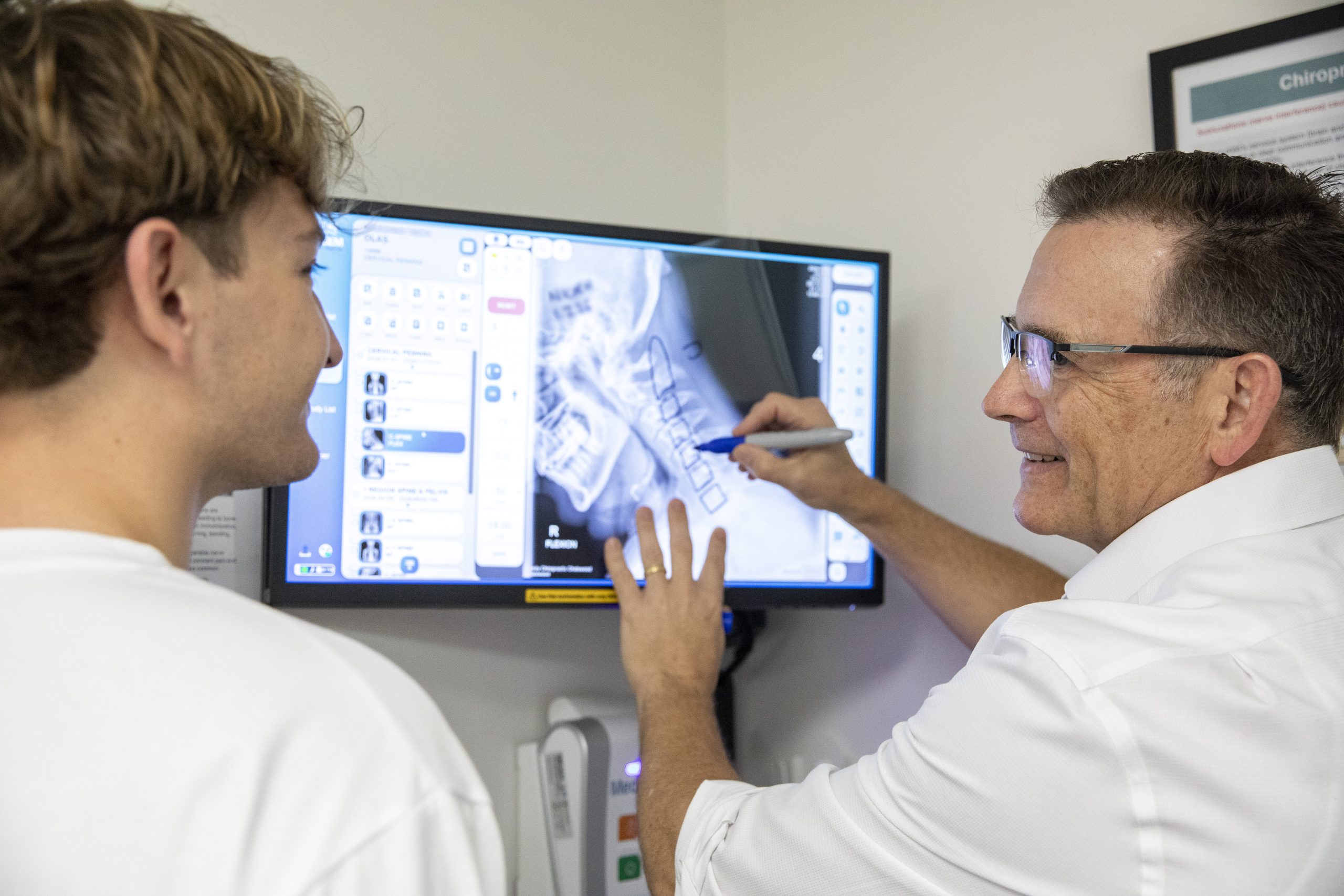
The upper cervical spine (the top of your neck) sits anatomically close to the brainstem — the very region where the vagus nerve originates.
Now, to be crystal clear: a chiropractic adjustment does not directly adjust the vagus nerve. But improving movement and function in the upper cervical region (C0, C1, C2) region influences the sensory input reaching your central nervous system.
Researchers such as Professor Heidi Haavik have demonstrated that spinal adjustments can alter brain processing, movement control and sensory integration — supporting the concept that chiropractic care affects brain–body communication.
More Than Just Neck and Back Pain
Most people first walk through our doors because of pain or postural issues— back pain, headaches, a stiff neck. But time and again, they mention other changes too: feeling calmer, sleeping better, more energy, less stressed, sharper concentration, an improved sense of wellbeing.
These are experiences patients commonly report. I’ve always described them as the wonderful “side effects” of caring for your nervous system as a whole. But, once you start to dive into how the nervous system works, both the sympathetic and parasympathetic, and realise how the stress response has such a huge influence over our physiology, you get to see the global impact of a system that does not adapt efficiently to its environment. Or perhaps over or under adapts due to an underperforming sensory nervous system. Why does this occur? Vertebral Subluxations, misaligned vertebra adding stress to the nervous system. that is where, by adjusting the spine, that these wonderful ‘side effects’ can be explained.
How to Support Your Vagus Nerve Every Day
Over the years we have forgotten how to live our best lives. Chiropractic care works at its best when it is in combination with a healthy (chiropractic) lifestyle. Here are six simple, science-backed habits I share with my Chatswood patients.
- Breathe slowly. Slow diaphragmatic breathing is one of the most effective ways to encourage parasympathetic activity. Try inhaling for 4 seconds, exhaling for 6, for five minutes. Even simpler, try ‘square breathing’ – breathe in for 4 seconds – hold for 4 seconds – exhale for 4 seconds – hold for 4 seconds. Repeat this 3 – 5 times
- Walk daily. Walking naturally regulates breathing, posture and nervous system activity. Even 20–30 minutes helps. Even better take your walk in nature.
- Prioritise sleep. Your nervous system repairs during quality sleep. Aim for a consistent bedtime, a dark, cool room. Ensure you take an eFast (no screens incl. TV) for at least 30 minutes prior to best.
- Improve your posture. Poor posture adds mechanical stress to muscles and joints. Small changes reduce unnecessary strain. Chest up and shoulders back!
- Eat whole foods. Your gut and vagus nerve are closely linked through the gut–brain axis. Vegetables, fruit, quality protein, healthy fats and fibre all help.
- Regular chiropractic care. Regular care helps to maintain healthy spinal function and support efficient brain–body communication as part of your overall wellbeing.
The Bigger Picture
The vagus nerve is one of your body’s most important communication pathways. While chiropractic care is not a treatment for vagus nerve disorders, research suggests spinal adjustments influence nervous system function and helps to support autonomic regulation in some people.
Combine that with good nutrition, movement, quality sleep and stress management, and you’ve got a genuinely powerful foundation for feeling your best.
At Family Chiropractic Chatswood, my goal has never been simply to help you feel better in the moment. It’s to help your nervous system function as well as it possibly can adapt to the ever changing world around you — so you can get better, stay well, and feel alive.
If you’d like to find out whether chiropractic care may be right for you, I’d love to meet you. We offer a genuine complimentary initial consultation so we can assess your individual situation and answer your questions — no pressure, no obligation.
📞 Call us on (02) 9415 4606 or book online at chatswoodchiropractic.com.au.
Frequently Asked Questions
Can a chiropractor stimulate the vagus nerve? No — chiropractors do not directly stimulate or treat the vagus nerve. However, chiropractic care help to support overall nervous system function, including the parasympathetic system the vagus nerve belongs to, by improving spinal movement and reducing mechanical spinal stress.
Can chiropractic help with stress? Research has observed changes in heart rate variability and stress responses following spinal adjustments, suggesting chiropractic may support parasympathetic activity. Individual results vary, and care is always tailored to your assessment.
Which part of the spine is related to the vagus nerve? The upper cervical spine (top of the neck – C0, C1, C2) sits close to the brainstem, where the vagus nerve originates. Improving movement in this region may influence sensory input to the central nervous system.
Is chiropractic a treatment for vagus nerve disorders? Chiropractic care is intended to support spinal function and nervous system health. It is not a a direct treatment for vagus nerve disorders or diseases of the autonomic nervous system.
How can I support my vagus nerve at home? Slow diaphragmatic breathing, daily walking, quality sleep, good posture, a whole-food diet, and regular chiropractic care & lifestyle can all help support parasympathetic activity.